South Africa: Where To See Penguins In The Wild
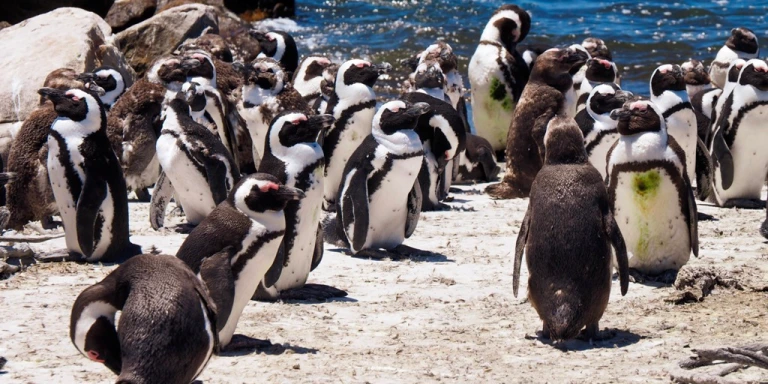
Most people associate penguins with Antarctica. But the African penguin (Spheniscus demersus) lives exclusively along the coast of South Africa and Namibia. These birds stand about 60 cm tall, weigh 2–3.5 kg, and are classified as Endangered by the IUCN. Their population has declined by over 60% in the last 30 years. Seeing them in the wild requires knowing exactly where to go, when to visit, and how to behave around them. This guide covers the four main sites where you can reliably see African penguins, with specific logistics for each location.
Boulders Beach, Simon’s Town: The Most Accessible Colony
Boulders Beach is the most famous penguin colony in South Africa. Located about 45 minutes from Cape Town city center, it sits within Table Mountain National Park. The colony started in 1982 with a handful of breeding pairs and now hosts roughly 2,000–3,000 birds. You can see penguins here 365 days a year.
What You Actually See
The colony occupies a sheltered cove with large granite boulders that break the surf. Penguins nest in the surrounding vegetation and under boardwalks. You walk on elevated wooden walkways that weave through the colony. The birds walk right under the boards, within arm’s reach (though touching is illegal). The water is calm enough for swimming, and penguins often float alongside swimmers. Boulders Beach is the only site in South Africa where you can swim with wild penguins legally.
Costs and Timings (2026)
Entry is managed by SANParks. As of 2026, the standard day visitor fee is R190 (about $10) for adults and R95 for children under 12. South African residents pay less — R50 for adults, R25 for children. The beach is open from 08:00 to 17:00 daily. The best viewing is between 09:00 and 11:00 when penguins return from feeding. Afternoons are quieter but hotter. Avoid weekends and public holidays if you want fewer people.
What Most Guides Get Wrong
Many travel blogs tell you to visit at sunset for “golden hour” photos. Ignore that advice. Penguins are least active during midday heat and at dusk. The actual failure mode here is arriving too late. By 15:00, many penguins are resting in burrows or under bushes, not visible from the boardwalk. Arrive by 09:00. Also, the parking lot fills by 10:00 on weekends. If you drive, arrive before 08:30 or take the train from Cape Town to Simon’s Town station, which is a 15-minute walk from the entrance.
Stony Point Nature Reserve, Betty’s Bay: The Quiet Alternative
Stony Point is 90 km east of Cape Town, about a 75-minute drive. It holds the second-largest breeding colony of African penguins on the mainland, with roughly 2,000 breeding pairs. Unlike Boulders Beach, there is no swimming — the water is too rough and cold. But the viewing is arguably better.
Key Differences from Boulders Beach
The walkway at Stony Point is a single 400-meter boardwalk that runs directly through the colony. Penguins nest under the walkway and in old wooden crates placed by conservation staff. You stand 1–2 meters from nesting birds. The colony is less crowded — on a Tuesday morning in January, you might share the boardwalk with 10 other people. Entry costs R50 per adult (2026), and there is a small parking area for free.
Stony Point is also a good site to see other seabirds: Cape cormorants, kelp gulls, and the occasional black oystercatcher. The reserve has a small interpretive center with a skeleton of a humpback whale and displays about the colony’s history.
When to Skip Stony Point
If you have only one day in Cape Town and want the iconic penguin-on-sand photo, go to Boulders Beach. Stony Point’s shoreline is sharp rocks and kelp — no sandy beach. The drive from Cape Town is winding and narrow in sections, especially the last 5 km through Betty’s Bay. Do not attempt this drive after dark. There are no streetlights and baboons sometimes sit on the road. Visit Stony Point as a half-day trip combined with the nearby Harold Porter Botanical Garden or the Kleinmond lagoon.
Robben Island: The Least-Known Penguin Colony
Robben Island, 11 km off the coast of Cape Town, is famous for Nelson Mandela’s prison. But the island also hosts a breeding colony of African penguins. The ferry departs from the V&A Waterfront in Cape Town. Tours run twice daily (09:00 and 13:00, 2026 schedule) and last 3.5–4 hours total, including the ferry crossing.
The penguin colony is on the eastern side of the island, near the old quarry. You see them during the bus tour portion of the visit. The bus stops at three points: the prison, the lighthouse, and the quarry. The penguin colony is visible from the quarry stop. You cannot walk among the penguins here. The bus driver will stop for 5–10 minutes. Bring binoculars. The colony size is smaller — roughly 500–800 birds — but the setting is historically unique.
Booking and Practicalities
Ferry tickets must be booked in advance through the Robben Island Museum website. Cost is R400 per adult (2026). The ferry is a catamaran and can be rough — if you get seasick, take medication 30 minutes before departure. The tour includes a 45-minute bus ride and a 60-minute prison tour led by a former political prisoner. The penguin viewing is incidental to the main tour. Do not book this trip solely for penguins. You will be disappointed by the limited viewing time and distance. Go for the historical experience; consider the penguins a bonus.
Dyer Island and Geyser Island, Gansbaai: The Boat-Based Option
Dyer Island, 8 km off the coast of Gansbaai (2 hours east of Cape Town), holds the largest African penguin colony in the region — roughly 5,000 breeding pairs. You cannot land on the island. But several boat operators run 2-hour trips that circle the island. These trips also pass Geyser Island, a smaller rock covered in Cape fur seals.
The boats are rigid-hulled inflatables (RHIBs) that hold 12–20 passengers. Operators include Marine Dynamics and Dyer Island Cruises. Cost is R950–R1,200 per person (2026). The boats depart from Kleinbaai harbor, which is a 5-minute drive from Gansbaai. The penguin viewing here is from 50–100 meters distance. You will see penguins on rocks, swimming, and rafting (floating in groups) on the water. You will also see seals, dolphins, and — between June and November — southern right whales.
Should You Do This Trip?
Only if you are already in Gansbaai for shark cage diving or whale watching. Driving 2 hours from Cape Town just for this boat trip is not worth it. The viewing is distant compared to Boulders Beach or Stony Point. The real value of Dyer Island is the combination of species. In a single 2-hour trip you can see penguins, seals, dolphins, and whales. If you want only penguins, stick to the mainland colonies. If you want a broader marine wildlife experience, this is your best option.
How to Choose: A Comparison Table
| Location | Distance from Cape Town | Penguin Count (approx.) | Entry Cost (2026) | Best For | Swimming? |
|---|---|---|---|---|---|
| Boulders Beach | 45 min drive | 2,000–3,000 | R190 adult | Close-up views, swimming | Yes |
| Stony Point | 75 min drive | 4,000 (breeding pairs) | R50 adult | Quiet, cheap, nesting views | No |
| Robben Island | 30 min ferry | 500–800 | R400 adult | History + penguins | No |
| Dyer Island (boat) | 2 hr drive + 2 hr boat | 5,000 (breeding pairs) | R950–1,200 | Multi-species wildlife | No |
Common Mistakes and How to Avoid Them
Mistake 1: Going to Boulders Beach at noon in summer. The sand reaches 45°C. Penguins hide in the shade. You will see mostly empty beach and tourists. Go before 10:00.
Mistake 2: Touching or feeding penguins. It is illegal under the CapeNature ordinance. Fines start at R5,000. Penguins have sharp beaks and can draw blood. More importantly, human contact stresses them and can transfer diseases. Keep 2 meters distance.
Mistake 3: Assuming all colonies are open year-round. Stony Point and Boulders Beach are open daily. But Dyer Island boat trips are weather-dependent. Between May and August, the wind often cancels trips. Have a backup plan.
Mistake 4: Not booking Robben Island in advance. Tickets sell out 3–7 days ahead during peak season (December–February). Book online at least one week before your trip. Walk-up tickets are rarely available.
Mistake 5: Wearing bright colors or making loud noises. Penguins are skittish near humans. Bright yellow or red clothing can alarm them. Wear muted earth tones. Speak in low voices on the boardwalks. If a penguin flinches or runs, you are too close or too loud. Back off.
African penguins are in decline. Every responsible visit helps fund conservation through entry fees. Choose one or two sites based on your schedule and interests. Boulders Beach is the best all-round choice for most travelers. Stony Point is the best for photographers and budget travelers. Robben Island is for history buffs. Dyer Island is for those who want the full Cape marine ecosystem. Plan your timing, respect the birds, and you will see these remarkable animals in their natural habitat.