Carnival Favourites With A Twist: Chocolate Custard Krapfen with Mezcal Icing
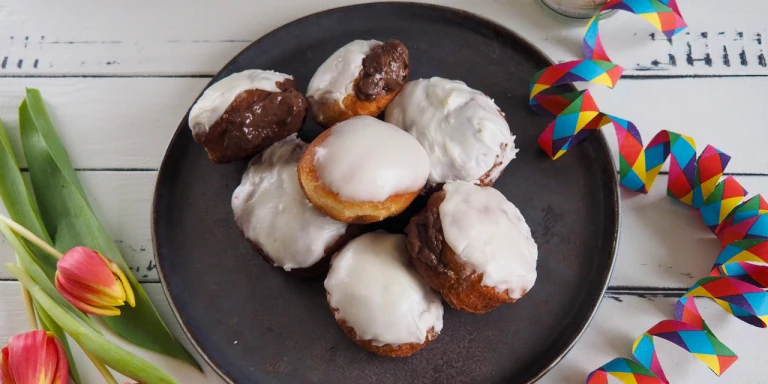
Venetians eat roughly 5 million fried pastries during the 10 days of Carnevale. Most are traditional — filled with jam, dusted with powdered sugar, forgotten by Ash Wednesday. But a newer version has been quietly winning arguments in bakeries from Vienna to São Paulo: the chocolate custard krapfen, finished with a smoky mezcal glaze.
This is not a gimmick. The combination works, and there’s a reason it’s appearing on carnival menus from Berlin’s Karneval to New Orleans’ Mardi Gras circuit. Here’s what you need to know.
Krapfen’s 500-Year History as Carnival’s Official Pastry
The krapfen predates almost every modern carnival tradition. Austria and Bavaria claim the oldest written recipes — some tracing back to the 17th century, though bakery historians point to even earlier fried-dough traditions in medieval German-speaking kitchens. The name itself likely comes from Krapfo, an Old High German word for hook or claw, referencing the shape early versions took before round became standard.
By the 18th century, krapfen had become inseparable from Fasching — the German-Austrian carnival season. The logic was practical: Carnival marked the last days before Lent. Fat, sugar, and eggs, the things you’d sacrifice for 40 days, went into one indulgent fried dough ball. Bakeries competed on filling and richness. The krapfen was essentially a Catholic countdown clock.
Italy adopted the form under different names. In Venice, the bombolone and fritola play the same role. In Rome, it’s the frappe and castagnole. But across all of them, the logic holds: deep-fried, filled, sweetened, consumed before abstinence begins.
What’s changed in the last decade is who’s filling them. Pastry chefs in Vienna — particularly at Café Central and smaller operations like Konditorei Oberlaa — have moved away from apricot jam toward custard-based fillings. Chocolate custard holds up better under the heat of frying and doesn’t weep into the dough the way fruit fillings sometimes do. The texture contrast — crisp exterior, yielding dough, cold dense custard center — is simply better.
The mezcal icing is a more recent addition. It comes from a specific cross-pollination of European carnival baking with Mexican festive food culture. Mezcal’s smoke doesn’t overpower chocolate — it amplifies the cocoa’s bitter notes while adding complexity that rum or bourbon can’t replicate. It’s the same interaction that has led chocolatiers at Valrhona to explore mezcal pairings across their single-origin collections.
The Carnival Food Calendar: When Krapfen Are Made
Krapfen production peaks between Epiphany (January 6) and Shrove Tuesday. In Austria, the Monday and Tuesday before Ash Wednesday — Faschingsdienstag — see bakeries sell out before noon. Vienna’s Bäckerei Ströck reportedly sells over 10,000 krapfen on Faschingsdienstag alone. Outside this window, finding a freshly fried krapfen at a traditional bakery is harder than it sounds. Most konditorei stop producing them entirely by mid-March.
How the Filling Tradition Evolved
Early krapfen used whatever preserve was available — rosehip, plum, quince. Apricot jam became dominant in Austria sometime in the 19th century and held that position for 150 years. The custard shift happened quietly, driven by Viennese konditorei competing on differentiation. Now vanilla custard, chocolate custard, and pistachio cream versions all exist alongside the classic apricot — and in upscale bakeries, apricot has started to feel like the legacy option.
Chocolate Custard vs. Jam: The Filling That Actually Works Better
This debate comes up every carnival season. The answer isn’t complicated. Chocolate custard wins on texture and stability. Jam wins on tradition and price. Here’s the actual comparison:
| Factor | Apricot Jam (Traditional) | Chocolate Custard | Vanilla Custard |
|---|---|---|---|
| Texture contrast with fried dough | High (syrupy, sharp) | Very high (dense, cool) | High (light, creamy) |
| Risk of dough sogginess | Medium-high (fruit acids) | Low (fat-based) | Low (fat-based) |
| Shelf life after frying | 4–6 hours | 6–8 hours refrigerated | 6–8 hours refrigerated |
| Works with mezcal icing | Poorly (competing acidity) | Excellently | Moderately |
| Cost premium over jam | Baseline | +€0.50–1.00 | +€0.30–0.70 |
| Availability at traditional bakeries | Ubiquitous | Specialty and artisan only | Increasingly common |
The practical takeaway: if you’re eating a krapfen at a festival stall, you’re probably getting apricot jam. If you’re paying more than €3 at a konditorei, ask about chocolate custard. The price difference is small. The experience gap is not.
The best chocolate custard krapfen use a dark chocolate pastry cream made with 60–72% cacao. Below that and it tastes sweet but flat. Above 75% and the bitterness fights the dough. Callebaut 811 dark chocolate (54.5% cacao) is the workhorse in commercial bakeries. Artisan operations lean toward Valrhona Guanaja 70% for more complexity — the difference shows up in the finish, not the first bite.
Why Mezcal Works Better Than Rum in This Icing
Rum is the default spirit in pastry icing. It’s the wrong choice here.
Rum’s sweetness competes with the chocolate custard filling. It stacks sugar on sugar without adding contrast. Mezcal does the opposite — its smoke and earth notes cut through the sweetness and make the chocolate read as darker and more complex than it actually is. The effect is similar to adding a pinch of salt to caramel: you’re not tasting the salt, you’re tasting the caramel more clearly.
The chemistry is straightforward. Mezcal’s phenolic compounds — produced during the roasting of agave piñas — interact with cocoa butter and sugar to create flavor contrast enhancement. You’re not getting a smoky krapfen. You’re getting a more intensely chocolate krapfen with a faint smokiness that fades after the first bite.
Which Mezcal to Use
Del Maguey Vida Single Village Mezcal ($45–55 for 750ml) is the benchmark for this application. It has enough smokiness to register in an icing without taking over. Montelobos Mezcal (around $40) is slightly lighter and a solid substitute when Del Maguey isn’t available. Avoid heavily smoked expressions like Del Maguey San Luis del Rio for baking — at the temperatures involved in icing preparation, the smoke dominates everything else.
The ratio matters more than the brand. Standard mezcal icing: 100g powdered sugar, 15ml mezcal, 5ml water, 5g cocoa powder. That yields enough for 6 krapfen. More than 20ml of mezcal per 100g sugar and the icing won’t set properly — it stays tacky indefinitely.
Can You Taste the Alcohol Once the Icing Sets?
The icing is not heated, so no alcohol burns off. A finished krapfen with mezcal icing contains roughly 0.5–1g of alcohol per pastry — comparable to a ripe banana. For most adults, this is not a concern. If you’re serving to children, substitute 15ml of cold-brew coffee concentrate. The bitterness profile is similar, the agave notes are absent, and the icing sets identically.
Four Signs a Krapfen Is Not Worth Buying
Most mediocre krapfen share the same flaws. Check these before committing to a purchase at any carnival stall or bakery counter:
- No pale band around the equator. A properly proofed krapfen shows a visible pale ring where the dough sat above the oil line during frying. No band means under-proofed dough. Dense, bread-like texture follows every time.
- The filling is too sparse. Bite into the center and hit dough on both sides? The baker used less than 30g of filling. A properly filled krapfen carries 35–50g of custard. Anything less and you’re paying for expensive fried dough.
- The icing is wet or sticky to the touch. Mezcal icing should be matte and dry within 20 minutes of application. Wet icing means the liquid ratio is off, or the krapfen wasn’t cooled before glazing. The icing soaks into the dough. It’s unpleasant.
- It was fried more than four hours ago. Krapfen stale faster than almost any other pastry. The crust softens, the custard develops a skin, the dough compresses. At a festival stall, ask when the last batch came out. A vague answer is your answer.
Supermarket krapfen sold in sealed plastic packaging during carnival season exist in a separate category. They’re edible. They share almost nothing with a fresh konditorei krapfen beyond the name. Skip them.
Where to Find Carnival Krapfen Worth Traveling For
Which City Has the Best Krapfen During Carnival?
Vienna during Fasching (late January through early March) is the clear answer. The density of konditorei in the first and third districts is unmatched anywhere in Europe. Café Central in the first district sells chocolate custard krapfen from mid-January. Konditorei Oberlaa at the Naschmarkt offers a rotating seasonal filling that has included mezcal-glazed versions in recent years. Café Sacher’s krapfen runs €5.50 — more expensive than most — but the house chocolate reputation justifies it at least once.
Is Venice Better for Carnival Pastries?
Venice’s carnival food culture runs parallel, not superior. The local default is the fritola — a smaller, denser fried dough with pine nuts and raisins. Pasticceria Rizzardini, open since 1742 near Campo San Polo, makes the most celebrated fritole in the city. For krapfen specifically, Venice lags behind Vienna and Munich. High tourist concentration near the Rialto Bridge means quality varies wildly. Stick to bakeries in Cannaregio or Dorsoduro for anything worth eating.
What About Carnival Pastries Outside Europe?
São Paulo’s German-Brazilian community in Blumenau produces krapfen during June’s Festa Junina, though the carnival link is looser. In the United States, New Orleans’ Mardi Gras centers on king cake rather than fried dough. Chicago’s Pilsen neighborhood, with its strong Mexican heritage, has seen mezcal-based desserts appear at carnival pop-ups in recent seasons — though krapfen remain rare outside European contexts.
The One Drink That Works With Chocolate Krapfen
Order a Melange — Vienna’s version of a flat white, equal parts espresso and steamed milk, served in a glass. The milk fat softens the mezcal’s smoke. The espresso amplifies the chocolate. Nothing else on a standard Viennese café menu comes close.
Sparkling water between bites resets the palate. Skip the hot chocolate pairing entirely — too much chocolate cancels the contrast you’re there for.
Making Chocolate Custard Krapfen at Home: Five Things That Matter
Most home krapfen recipes fail at the same points. Get these right and the rest is straightforward.
- Use bread flour, not all-purpose. Higher protein content (12–14%) builds the gluten structure that holds custard without collapsing during frying. King Arthur Bread Flour is the easiest to source in the US. In Europe, use Type 550 flour (German classification) or Manitoba flour in Italy.
- Fry at exactly 170–175°C (338–347°F). Too hot and the outside browns before the center cooks through. Too cool and the dough absorbs oil. Use a probe thermometer. The pale equatorial band only forms at the correct temperature — it’s your visual confirmation the proofing worked.
- Make the chocolate custard a day ahead. Fresh custard is too warm and too loose to pipe cleanly. Refrigerate overnight — it stiffens and the chocolate flavor deepens. Use a piping bag with a 1cm nozzle, inserted into the side of the krapfen three-quarters of the way through before piping.
- Apply mezcal icing when the krapfen sits at room temperature (20–25°C), roughly 15 minutes after frying. Hot krapfen melt the icing immediately. Cold krapfen cause it to crack. Time it correctly and the icing sets matte within 20 minutes.
- Use Nielsen-Massey Madagascar Bourbon Vanilla bean paste in the custard — not extract. The bean paste gives the chocolate custard a depth and visual interest that extract flattens. One bean’s worth of paste per 500ml of milk is standard. Yes, it’s expensive. A krapfen that took four hours to make deserves the right vanilla.
The full cycle — dough, proof, custard, fry, fill, ice — runs about four hours start to finish. A batch of 12 is the minimum worth attempting. Below that, oil temperature fluctuates too much between batches and the results are inconsistent.
The first time a visitor to Venice’s Carnevale bites into a freshly fried fritola and tastes nothing but sugar and oil, they leave a little disappointed. The second time — when they find their way to a proper konditorei, order the chocolate custard krapfen, and catch the mezcal smoke rising through the sweetness — the memory locks. That’s why 5 million of them disappear in 10 days.